Former captains criticise saffron hockey jersey ahead of World Cup

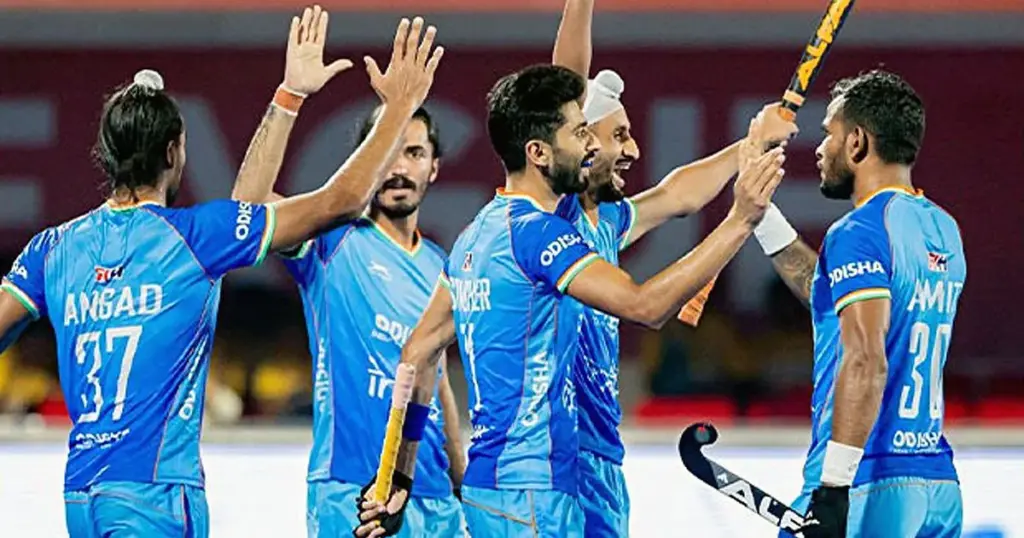
The decision to designate saffron as the primary jersey colour for the Indian hockey team in the upcoming World Cup has drawn criticism from former captains Pargat Singh and Dhanraj Pillay. Both individuals have stated that the blue jersey has long been the established identity of the team. The World Cup is scheduled to commence on August 15 in the Netherlands and Belgium.
The debate began following Hockey India‘s unveiling of the new kit for both the men’s and women’s teams in anticipation of the tournament. Pargat Singh, a former India captain, expressed his disapproval, remarking that “Everything in the country is being saffronised.” He further commented on the broader implications, stating that “education, history and now sports too” are undergoing this change, which he finds “worrying.” He emphasised that sports typically unite people and transcend religion, caste, and politics, making it unfortunate if such considerations enter the realm of sports.
Concerns over traditional identity
Dhanraj Pillay, who represented India in 339 international matches, including four Olympics, four World Cups, and four Champions Trophy tournaments, highlighted that the blue jersey has been associated with Indian hockey for decades. He noted that saffron, as one of the colours of the national flag, holds importance and is considered auspicious. However, he stressed that it has never been the traditional colour for Indian hockey. Dhanraj Pillay expressed his confusion regarding the sudden change after many years.
He recounted that from the 1928 Olympic team through the eras of prominent players like Dhyan Chand, Balbir Singh Sr., Mohammad Shahid, and Zafar Iqbal, including the 1980 Moscow Olympic gold medal-winning side, all teams played in the blue jersey. Dhanraj Pillay himself played for nearly 15 years, during which the team’s jersey consistently remained blue. He asserted that players identify with the traditional colours of their national team, distinguishing it from franchise tournaments like the IPL or Hockey India League, where teams wear various colours. According to him, the Indian team‘s identity has always been the blue jersey.
Former India captain Viren Rasquinha has also voiced reservations concerning the change. Despite these concerns, Hockey India has maintained that the decision was made after considering technical feedback from coaches and players, as well as the symbolic significance of saffron as a colour present in the National Flag.
Addressing the blue turf argument
Dhanraj Pillay also challenged the argument that the change was necessary because hockey is now played on blue astro turf. He pointed out that the team has been playing on blue turf for several years without any reported issues related to jersey colour. He questioned whether the International Hockey Federation (FIH) had issued any directives indicating difficulties with a blue jersey on blue turf.
Pargat Singh similarly dismissed Hockey India‘s explanation that the change aimed to improve visibility on blue turf. He stated that he had never encountered such a problem during his playing career. He further questioned why, if visibility were a concern, only saffron was chosen, implying that other colour options might have been available. Pargat Singh also rejected the claim that the decision was based on feedback from players and coaches, suggesting that such recommendations are not typically made by them. He noted that the FIH already has India’s traditional jersey colours registered.
Pargat Singh highlighted that generations of Indian players, from historical figures to the current squad, have represented India in blue. He mentioned that iconic photographs of Indian hockey consistently show players wearing blue, and even during their playing days, training was conducted in blue, solidifying its status as the identity of Indian hockey. While India traditionally used a white change kit, the saffron jersey has now been registered as the primary strip, a decision for which Pargat Singh stated he saw no logical basis.
Dhanraj Pillay recalled one instance where India wore a yellow shirt with blue shorts in a match against Argentina during the 1992 Barcelona Olympics, noting it as a rare exception to the blue jersey tradition.
Source: timesofindia.indiatimes.com

