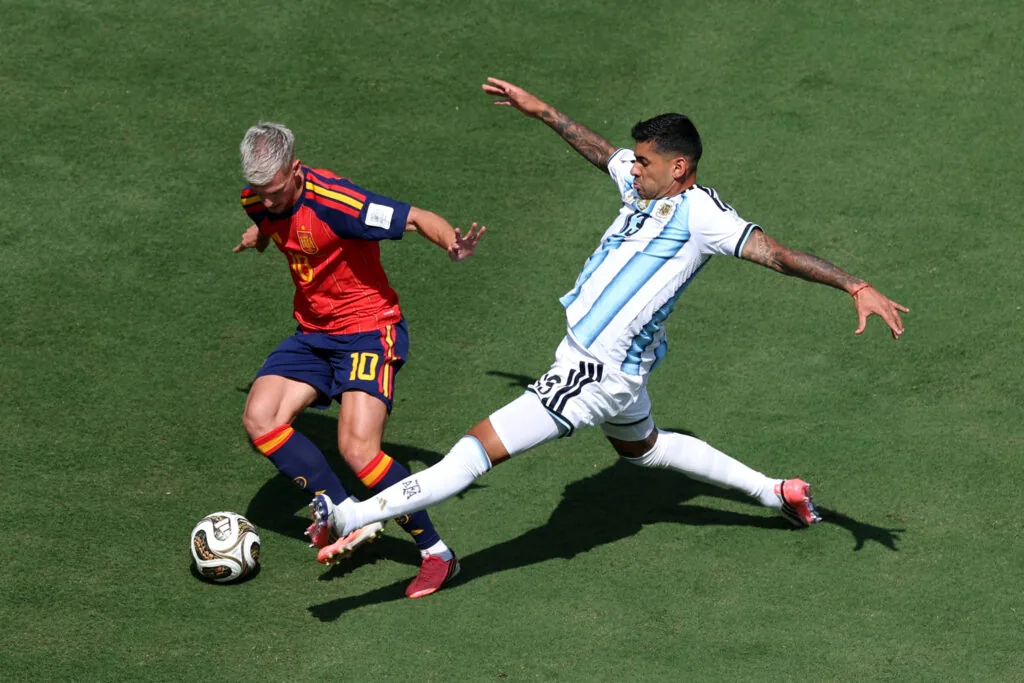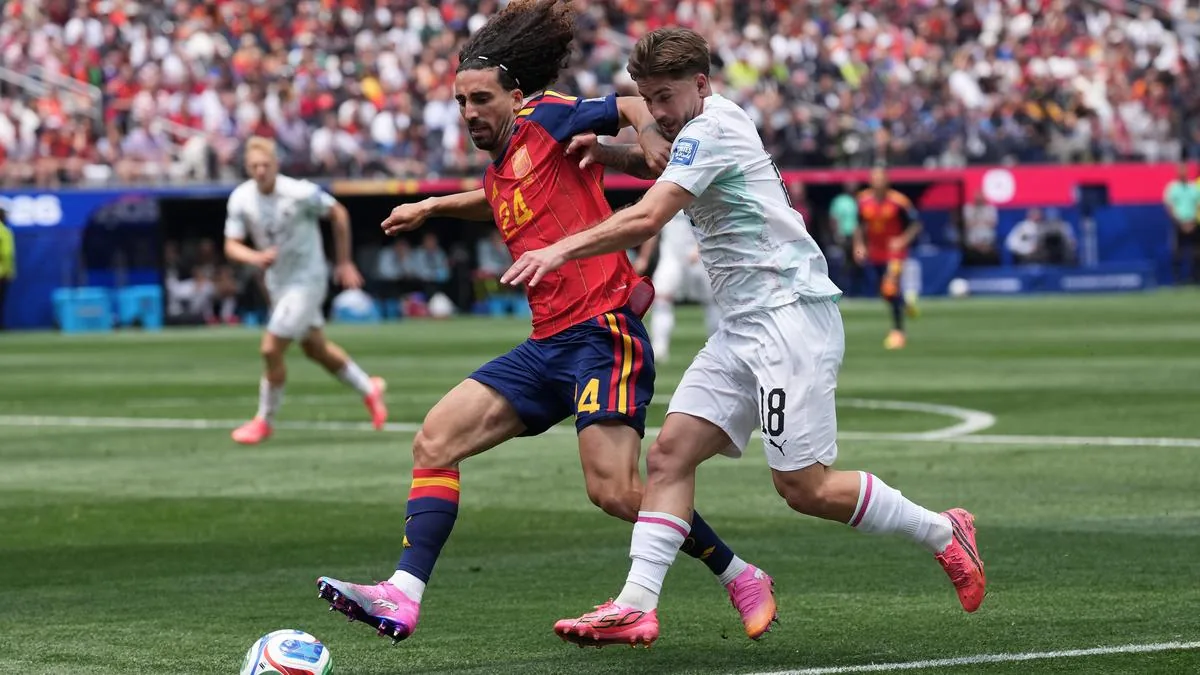
Spain believed they had taken the lead in their FIFA World Cup 2026 Round of 32 match against Austria in Los Angeles when Marc Cucurella found the net from a corner kick. However, the goal was ultimately disallowed, causing confusion among fans present at the stadium.
The incident occurred just before the half-hour mark. Spain earned a corner, and the ball fell to Cucurella amidst a scramble in front of the penalty box. The Real Madrid full-back struck the ball into the net and began to celebrate, but referee Glenn Nyberg subsequently ruled out the goal.
Reason for Disallowed Goal
The decision to disallow Cucurella’s goal stemmed from a foul identified in the build-up to the score. Referee Nyberg determined that Pau Cubarsi had fouled Austrian goalkeeper Alexander Schlager. This foul violated Rule 10.1 of the laws of football, as established by the International Football Association Board (IFAB).
Rule 10.1 states that a goal is scored when the entire ball crosses the goal line, between the goalposts and under the crossbar, provided that no offence has been committed by the team scoring the goal. Cubarsi’s action was deemed to have violated this clause, providing sufficient grounds for the referee and the Video Assistant Referee (VAR) team to disallow the goal.
Reports indicate that the VAR review specifically determined that a Spanish player, positioned offside, interfered with the Austrian goalkeeper. This decision was made under FIFA Law 11’s offside interference clause, even though the player did not touch the ball. The call has reportedly ignited significant debate regarding consistency in officiating.

The 5W+H analysis of the incident identifies Marc Cucurella as the scorer of the disallowed goal, with the VAR review panel and the on-field referee making the final decision. The contested phase of play involved the Austrian goalkeeper and defenders. The incident occurred during the Spain versus Austria group-stage match at the 2026 FIFA World Cup, which is being hosted across the United States, Mexico, and Canada.
The goal was disallowed because VAR reportedly identified that a Spanish player, despite not touching the ball, occupied an offside position and was judged to have interfered with the opposing goalkeeper’s ability to make a save. This falls under a specific clause within FIFA’s offside law. The process involved semi-automated offside technology (SAOT) flagging the offside position, followed by the VAR team assessing whether the offside player’s proximity constituted ‘interference with an opponent’ under Law 11, Section 2, leading to the recommendation to disallow the goal.
Impact of VAR and Offside Rules
The ‘interference with an opponent’ clause in Law 11, Section 2, penalises a player in an offside position if they ‘clearly attempt to play a ball which is close when this action impacts on an opponent’ or if they make ‘an obvious action which clearly impacts on the ability of an opponent to play the ball.’ The IFAB’s 2024–25 guidance notes expanded this interpretation to include scenarios where an offside player’s proximity ‘prevents an opponent from playing or being able to play the ball by clearly obstructing the opponent’s line of vision or movement.’
This means that even without touching the ball, moving, or waving arms, if a referee or VAR panel judges that a player’s body in an offside position made it harder for the goalkeeper to perform their duties, the goal can be disallowed. Semi-automated offside technology can accurately determine offside positions, but the assessment of ‘interference’ remains a subjective human judgment, which is reportedly a central point of Spain’s complaint.
Spain’s coaching staff have reportedly questioned the consistency of such decisions, pointing to what they describe as at least one comparable situation earlier in the tournament where a similarly positioned offside player was not penalised, and the goal stood. This raises questions about whether the system is truly eliminating subjectivity or merely relocating it behind a screen. The argument from the Spanish camp revolves around two main points: the degree of interference and consistency in application.
They have reportedly questioned whether the offside player genuinely obstructed the goalkeeper’s line of sight, noting that the goalkeeper appeared to dive in the correct direction, suggesting he might not have been impeded. If the goalkeeper saw the ball, tracked it, and moved towards it, the question arises as to how a player at his periphery could have ‘clearly impacted’ his ability to make the save. The incident has contributed to broader discussions about VAR controversies at the 2026 World Cup, with other officiating decisions also drawing criticism regarding consistency.
The Cucurella incident has become a significant talking point of the tournament, not just for what happened on the pitch, but for the role of the VAR booth in the decision-making process. The technology reportedly functioned as intended, but the debate centres on whether the rule it enforced was designed for such a moment. This situation implies that every remaining team in the knockout rounds must now consider the risk that any set-piece goal could be retroactively disallowed due to the position of a teammate who never touched the ball.
Read Also
Source: sportstar.thehindu.com

Priya Nair
Sports Reporter