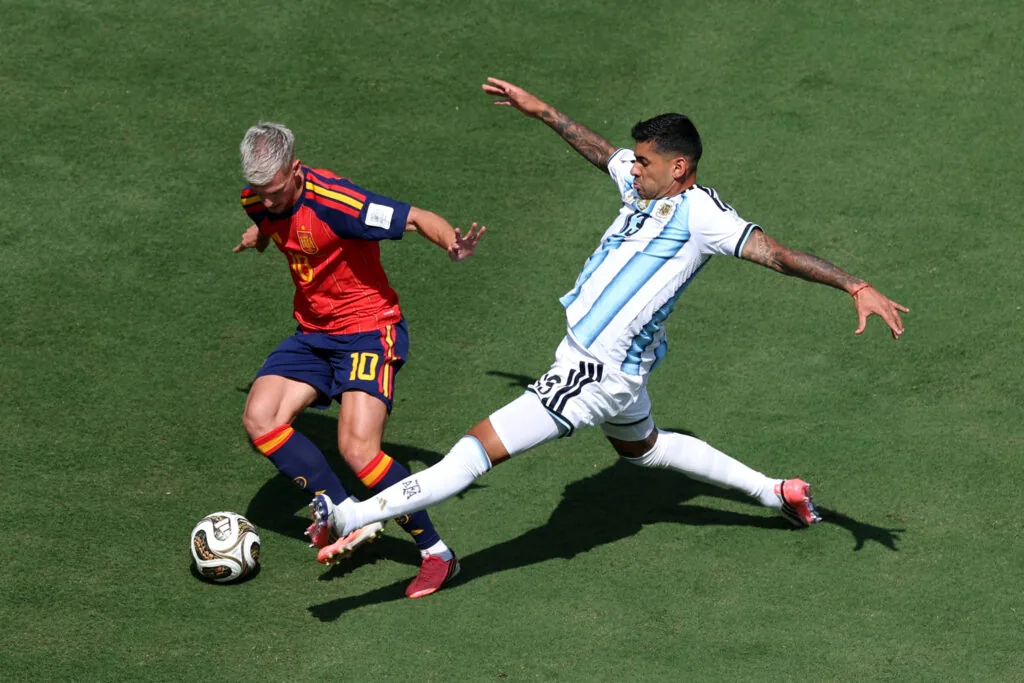
Lionel Messi has responded to critics regarding Argentina’s journey to the FIFA World Cup final, asserting that the defending champions have earned their position through performance rather than favourable officiating or external influence. Argentina secured a place in the final after a victory against England, winning 2-1 in a semifinal match. This win led to widespread celebrations in Buenos Aires, with many fans filling the streets as Argentina moved closer to potentially winning consecutive World Cups.
The team has demonstrated a pattern of comebacks throughout the tournament. Argentina had previously overcome Switzerland in extra time and recovered from a deficit to defeat Egypt. These victories, however, have also drawn criticism, with coaches from Switzerland and Egypt questioning refereeing decisions after their defeats. The coach of Egypt, Hossam Hassan, even suggested that his team was disadvantaged by a football establishment that favoured Messi and Argentina.
Addressing the allegations
These complaints have been amplified by some fans who argue that the World Cup bracket benefited Argentina. Additionally, claims have circulated on social media suggesting that FIFA desired the defending champions to retain the title. Messi dismissed these suggestions following the win against England.
“We’ve been the best over these past four years, either you like it or not, and no matter what anyone says,” Messi stated after the match. “Once again, we’ve established ourselves among the top two teams in the world. That proves that everything we’ve done is no fluke and that nothing was handed to us.”
Previously, Argentina had largely refrained from addressing these favouritism allegations. Coach Lionel Scaloni had advised journalists to “not to consume so much social media” when questioned about the issue in earlier press conferences. However, after reaching another World Cup final, the reigning champions chose to respond.
“Reaching two consecutive World Cup finals is something very few achieve, and this group did it,” Messi added. “If we had lost to England, there would have been people coming out to spout some nonsense, but we didn’t give them the chance.”
The semifinal against England also rekindled a long-standing football rivalry, influenced by historical disputes. The British government urged FIFA to investigate Argentina after players celebrated the win by posing with a banner that read, “Las Malvinas son Argentinas” (The Malvinas are Argentine), which was given to them by supporters.
Midfielder Enzo Fernandez indicated that his celebration after scoring Argentina’s equaliser conveyed a message to those criticising the team. Fernandez made a gesture, widely interpreted in football as telling critics to continue talking, by cupping his hands to his ears before repeatedly opening and closing his fingers. “There was a lot of talk; it was a mix of euphoria and frustration,” Fernandez commented.
Online petition and fan reactions
An online petition, reportedly signed by over 10 million people, has emerged, demanding Argentina’s expulsion from the 2026 FIFA World Cup due to allegations of refereeing bias and FIFA favouritism. These allegations include claims of systematic refereeing bias, favourable officiating, and suggestions that FIFA is making efforts to ensure Messi and the defending champions continue their journey.
Akhil Ratra, a Football Content Creator, views the petition as an overreaction but acknowledges the underlying frustration. He notes that discussions about controversial refereeing decisions involving Argentina have resurfaced across multiple tournaments, not just the current one. Ratra suggests that when supporters consistently perceive similar incidents being judged differently, they may question the consistency of standards. While he believes expelling Argentina is unrealistic, he cautions against dismissing the concerns of millions of fans.
The digital age has transformed supporters into commentators, with every contentious refereeing decision quickly spreading globally. Aashish Pandey, a Football Enthusiast and Content Creator, believes the allegations are driven more by perception than concrete proof. He explains that major teams and star players inevitably face greater scrutiny, magnifying every contentious decision. Pandey, while a Cristiano Ronaldo supporter, stresses that disappointment after a defeat should not be mistaken for evidence of systemic bias, noting that refereeing and VAR decisions are made under immense pressure.
Sarthak Bose, a Professional Football Player & Football Content Creator, adds that refereeing mistakes are an inherent part of football. He suggests that, without solid proof of bias, many reactions stem from emotions following significant matches. Bose explains that football’s emotional nature makes it susceptible to conspiracy theories, particularly when involving global figures like Messi or institutions such as FIFA. Controversial clips often gain more attention than detailed explanations, allowing speculation and sensational narratives to spread rapidly on social media.
Hans Gupta, a Football Content Creator & Enthusiast, believes the core issue behind the online backlash is the perception of inconsistent refereeing, rather than a coordinated conspiracy. He points out that fans become increasingly sceptical when similar incidents appear to be officiated differently in high-stakes matches. Gupta cites instances where certain challenges receive extensive VAR scrutiny while others seem to pass without review, creating an impression of uneven application of standards. He also referenced Argentina’s match against Egypt, where a disallowed Egyptian goal following a VAR review and an unpunished late challenge before Argentina’s winning goal intensified public debate.
Despite its online momentum, the petition faces FIFA’s regulations. Sarthak Bose notes that FIFA makes decisions based on its rules and official processes, not on online trends. National teams cannot be removed from the World Cup solely because of disagreements over refereeing decisions or sporting outcomes. Suspensions are typically reserved for defined breaches of FIFA statutes, such as government interference, corruption, discrimination, or other violations. Therefore, while public opinion may dominate online discussions, it does not dictate tournament participation, and the petition carries no legal authority over FIFA’s disciplinary processes.
The Qatar 2022 World Cup triumph for Argentina also triggered widespread allegations of refereeing bias and favourable VAR decisions. Similar questions about refereeing consistency have arisen during the ongoing tournament, including after England’s quarter-final victory over Norway, where contentious officiating decisions sparked heated debate online.
Read Also
- Barcelona connection: Messi and Yamal set to meet in World Cup final after iconic photo resurfaces
- White House defends Argentina team over Falklands banner incident
- Kansas City: England coach Thomas Tuchel addresses squad after World Cup semi-final defeat
- New York faces smoke, travel concerns ahead of World Cup final
Source: timesofindia.indiatimes.com

Priya Nair
Sports Reporter